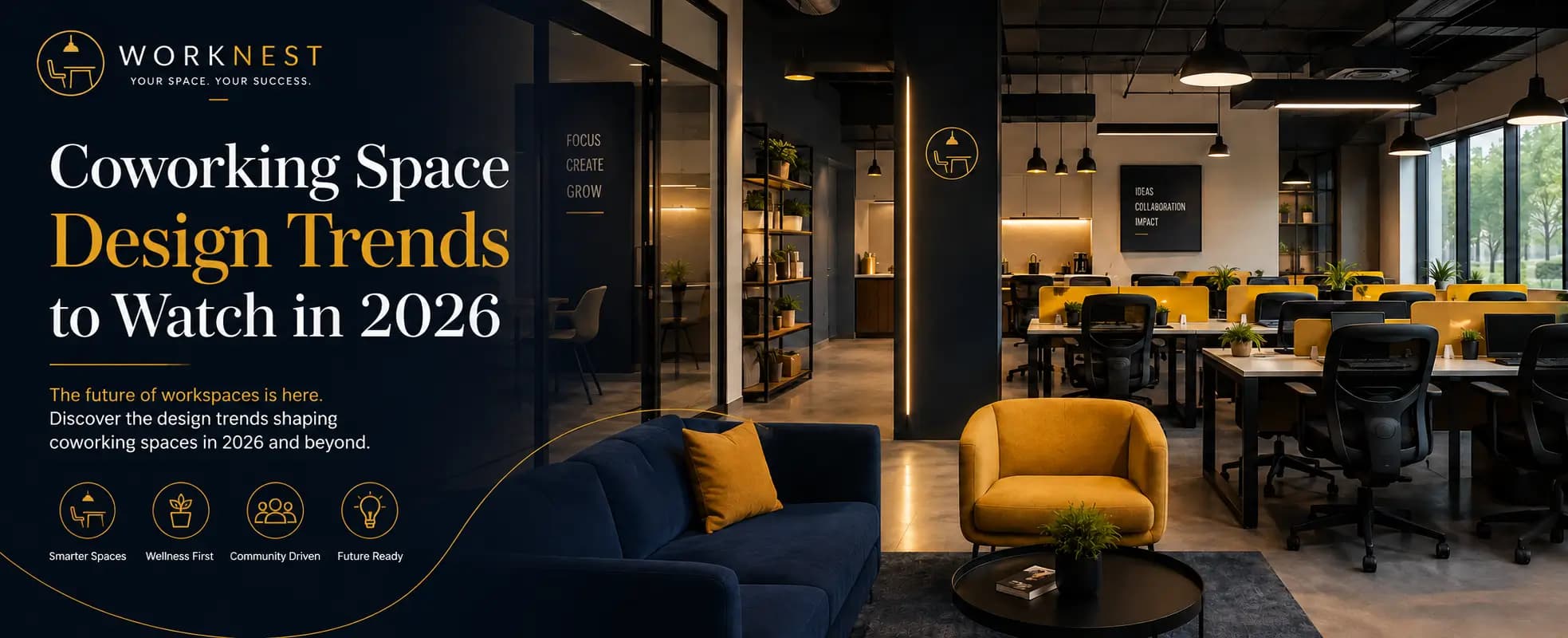
The biggest coworking space design trends of 2026 are acoustic zoning for focus work, immersive biophilic design, hybrid-ready modular layouts, wellness-led amenities, and climate-smart local design, and at WorkNest in Mansarovar, Jaipur, most of these are already built into the floor plan, not just on a mood board. Global trend reports from Mindspace and Gable cover the first four well. What they miss is how these ideas actually perform in an Indian city, where 45°C summers, dust, and local material costs change what “biophilic” or “acoustic zone” really means in practice. This guide closes that gap.
Why coworking design matters more in 2026
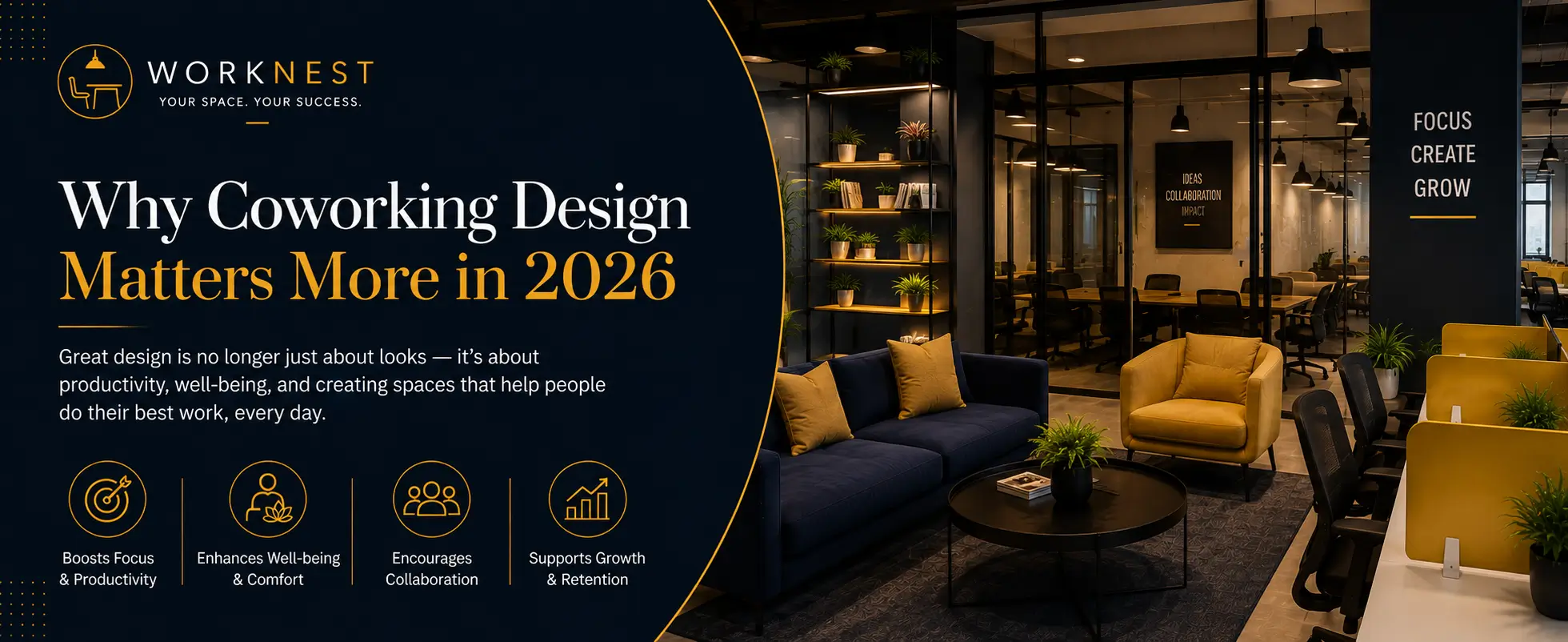
Design used to be an afterthought, paint, plants, a few beanbags. Not anymore. As of 2026, coworking office design decisions directly affect member retention, and operators who get it wrong lose members to home offices instead of to competitors. Nearly three in four US employees report moderate to very high stress at work, according to Aflac’s 2025 WorkForces Report, and design is one of the few levers a workspace controls to reduce that. The single most-requested workplace element in employee surveys is natural light, which is exactly why biophilic design keeps topping every 2026 trend list.
Below are the six trends shaping coworking space design in 2026, each with a one-line takeaway you can scan and act on.
1. Acoustic zoning and quiet pods, 2026’s most-requested feature
Takeaway: Members rank quiet, distraction-free zones above almost every other amenity, so 2026 layouts separate focus work from collaboration by design, not by request.
Roughly 85% of employees say access to quiet zones significantly improves their productivity, according to the International Workplace Group. That single statistic explains why acoustic panels, felt baffles, and enclosed booths have moved from “nice to have” to a baseline design requirement in 2026 fit-outs.
At WorkNest, this shows up as a genuine split between desk types rather than a shared open floor. The Hot Desk area supports drop-in, lower-noise work; Private Cabins give founders and consultants a fully enclosed space for calls and deep work; and Meeting Rooms are booked by the hour, so ad-hoc collaboration never spills into someone else’s focus time.
2. Biophilic design goes beyond a few potted plants
Takeaway: 2026 biophilic design means daylight, natural materials, and airflow engineered into the layout, not decoration added after the build.
Small businesses see the fastest returns from high-impact, low-cost biophilic moves, plants for greenery, LED lighting upgrades, and acoustic panels for quiet corners. Coworking office design 2026 treats biophilic design as a wellbeing strategy, not a style choice, because integrating daylight, greenery, and natural textures creates spaces that are psychologically and physically restorative.
Jaipur adds a twist competitors ignore. Jaipur’s May average daytime high reaches roughly 42°C (108°F), among the hottest of any major Indian city, so direct daylight also means direct heat for most of the pre-monsoon season. Biophilic design coworking spaces here need diffused natural light, jaali-inspired screens, shaded courtyards, or tinted glazing, so members get the wellbeing benefit of daylight without the glare and heat load. This is the kind of India-specific design detail missing from both Mindspace’s and Gable’s 2026 trend pieces.
3. Hybrid-ready, modular layouts
Takeaway: With hybrid work now standard, 2026 offices are designed to be rearranged weekly, not renovated yearly.
Over 28% of the workforce now works in a hybrid pattern, and the surge in video calls has made acoustic design and flexible layouts critical rather than optional. Hybrid work office design in 2026 means furniture on wheels, desks that convert from solo to team configurations, and bookable spaces instead of fixed assignments, because occupancy on any given day is unpredictable by nature.
WorkNest’s four-tier model (Hot Desk, Dedicated Desk, Private Cabin, Meeting Room) is effectively pre-built for hybrid patterns: a hybrid employee can drop in on a Hot Desk two days a week and upgrade to a Dedicated Desk once their routine settles, without switching buildings.
4. Local-first design: Jaipur’s climate and culture, not a global template
Takeaway: The biggest coworking design gap in 2026 is that most trend guides are written for London, New York, or Dubai, not for a Rajasthani summer.
This is the trend competitors skip entirely. Both Mindspace and Gable publish comprehensive, well-cited 2026 trend pieces, but neither addresses India or Jaipur design conditions, and neither ties a single recommendation back to a real, visitable space. A biophilic wall that thrives in coastal Lisbon can struggle in Jaipur’s dry heat without the right plant selection and irrigation. Acoustic design also has to account for local ambient noise, traffic, construction, and open-window ventilation habits, that differ from a climate-controlled Western office tower.
WorkNest’s Mansarovar location was built around these local realities rather than importing a generic template, which is precisely the gap-close this article is meant to demonstrate.
5. Wellness-led, neuroinclusive amenities
Takeaway: 2026 design gives members choice, quiet, social, or focused zones, instead of forcing everyone into one open floor plan.
Thoughtful lighting, ergonomic setups, and well-planned quiet zones create a more personalised experience that also supports neurodiverse employees who benefit from variety and choice in where they work. This is a meaningful shift from 2020-era open-plan coworking, where every member worked in the same loud, bright, all-purpose room regardless of their task or sensory needs.
6. Private, enclosed spaces are outpacing open-plan by design
Takeaway: 2026 coworking spaces are adding more enclosed, bookable rooms because members are choosing focus over open collaboration by a wide margin.
Industry data backs this shift clearly: private offices and focus pods are significantly outpacing open-plan seating in new 2026 coworking build-outs, per Gable’s workplace research (exact ratio to be confirmed against Gable’s published source before publishing). WorkNest’s Private Cabin and Meeting Room options are a direct response to that same demand, spaces members can book and close the door on, rather than compete for in an open room.
Coworking Space Design Trends 2026, At a Glance
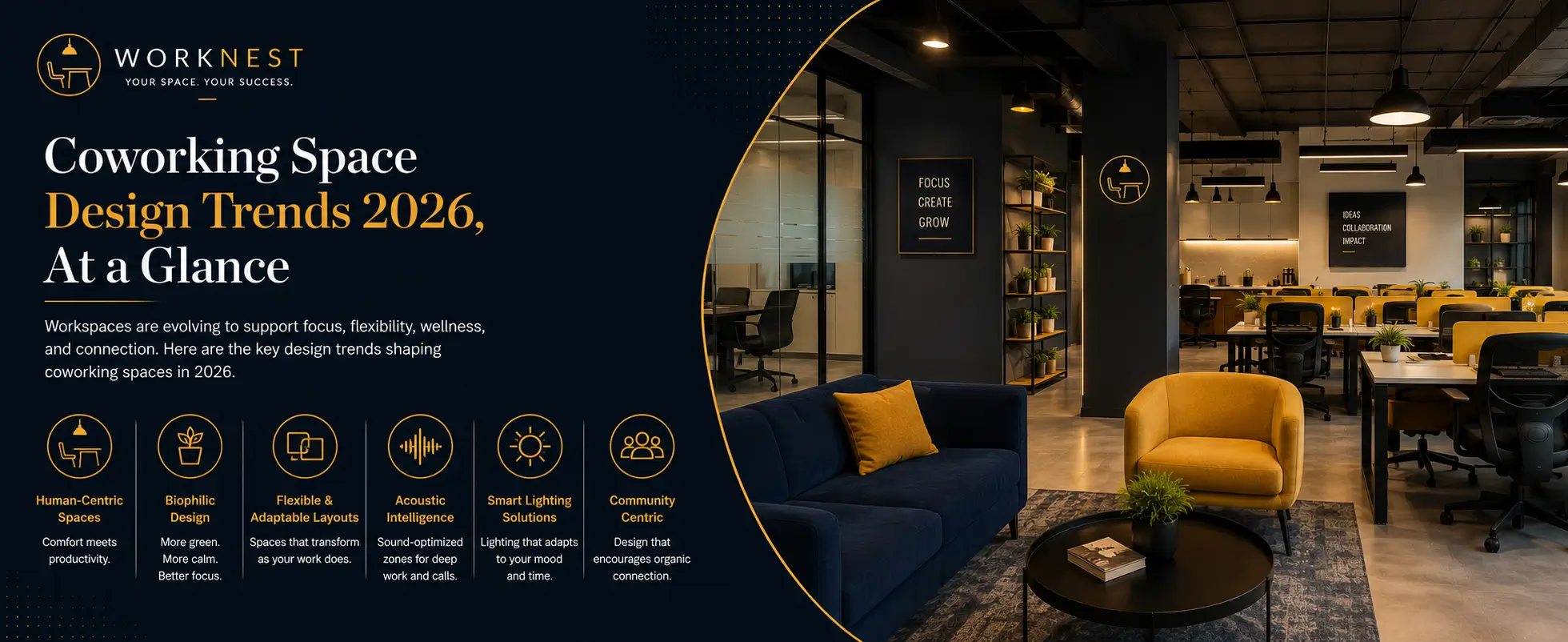
| Trend | One-line takeaway | Where to see it at WorkNest |
| Acoustic zoning & quiet pods | Focus work needs a separate zone by design, not by request | Private Cabins, enclosed Meeting Rooms |
| Biophilic design | Daylight and natural materials engineered in, not decorative | Diffused daylight, plant zones suited to Jaipur’s climate |
| Hybrid-ready modular layouts | Furniture and space rearrange around unpredictable occupancy | Hot Desk to Dedicated Desk flexibility |
| Local-first (India/Jaipur) design | Global templates ignore Indian climate and culture | Heat- and dust-aware layout choices in Mansarovar |
| Wellness-led, neuroinclusive design | Members get a choice of environment, not one-size-fits-all | Distinct zones for quiet, social, and focused work |
| Private space growth | Enclosed rooms are significantly outpacing open-plan | Private Cabins, hourly Meeting Rooms |
What this means if you’re choosing a coworking space in Jaipur in 2026
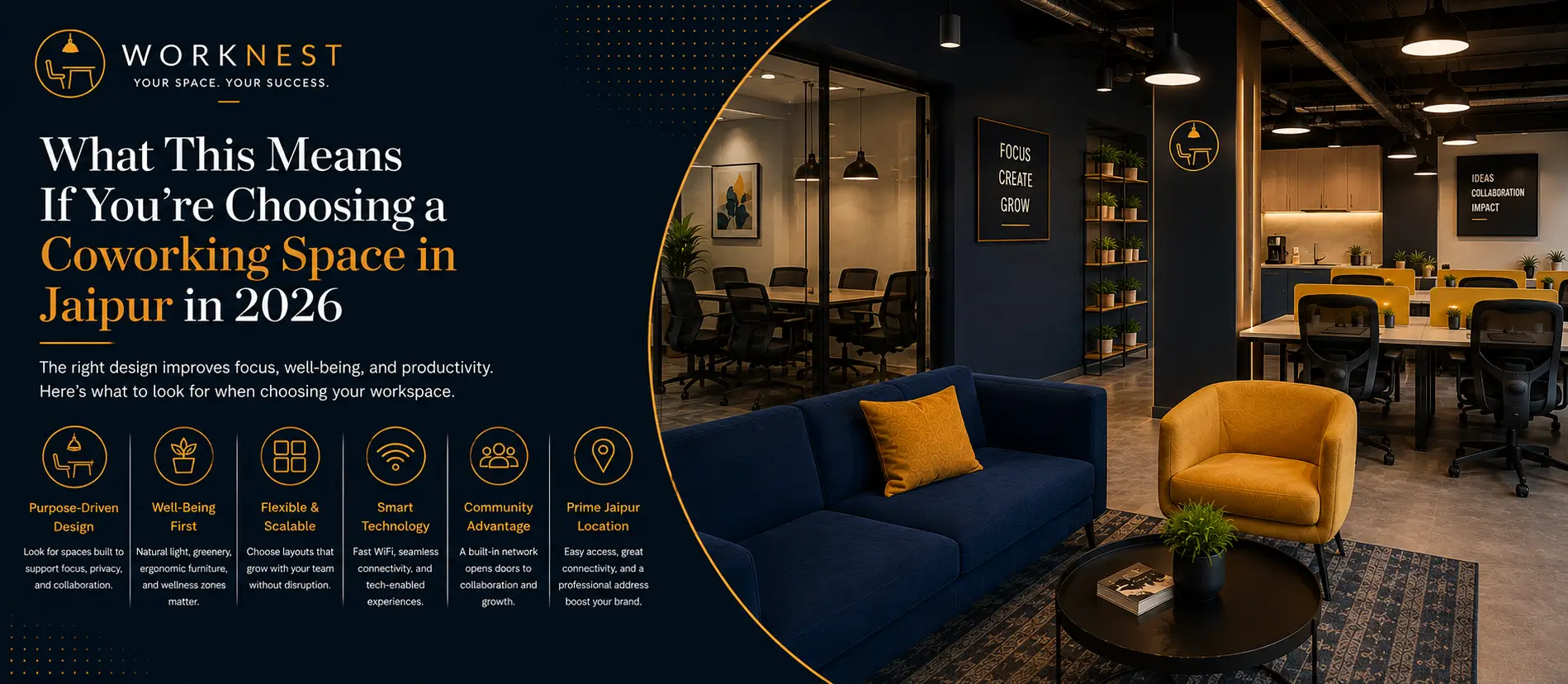
If you’re comparing coworking office design 2026 options, ask two questions most brochures won’t answer: does this space actually manage Jaipur’s heat and dust, or does it just look good in photos taken elsewhere? And does the layout give you a genuine choice between quiet, focused, and social zones, or is it one open room with a plant in the corner?
WorkNest at a glance, pricing (as of 2026)
| Plan | Price | Best for |
| Hot Desk | ₹699/day | Drop-in work, remote employees testing the space |
| Dedicated Desk | ₹9,999/month | Freelancers and consultants who want a fixed spot |
| Private Cabin | ₹24,999/month | Founders and small teams needing enclosed, quiet space |
| Meeting Room | ₹799/hour | Client meetings, interviews, focused team sessions |
WorkNest has served 500+ businesses out of its Mansarovar location, holds a 4.8 Google rating, and sees a 91% member renewal rate, a strong signal that the design choices above hold up under daily, real-world use rather than just looking good in launch photos. New enquiries get a response within 30 minutes.
“The private cabin setup meant I could take client calls without booking a separate room every time,” says Aditi Rao, Founder, a WorkNest member. Meanwhile, Priya Singh, Freelance Designer, notes that the quieter desk zones made it easier to focus during deadline weeks, a direct example of acoustic zoning working as intended.
The bottom line
Coworking space design trends in 2026 are converging on one idea: give members choice, quiet or social, enclosed or open, fixed or flexible, instead of forcing everyone into the same room. Biophilic design, acoustic zoning, and hybrid-ready layouts all serve that same goal. What most 2026 trend guides miss is that these ideas need to be adapted to local conditions, not copy-pasted from a global template. That’s the standard WorkNest was built to.
Ready to see these design trends in a real, visitable space? Book a Free Office Tour at WorkNest, E-3, 6D Engineers Colony, Mansarovar, Jaipur 302020.
FAQs
Q1: What are the top coworking space design trends for 2026?
A: The top trends are acoustic zoning and quiet pods, immersive biophilic design, hybrid-ready modular layouts, wellness-led neuroinclusive amenities, and a growing share of private, enclosed spaces over open-plan seating.
Q2: What is biophilic design in a coworking space?
A: Biophilic design coworking spaces integrate natural light, plants, and natural materials into the layout to reduce stress and improve focus, rather than adding greenery as decoration after the space is built.
Q3: Why are quiet zones important in coworking spaces?
A: About 85% of employees say quiet zones significantly improve their productivity, according to the International Workplace Group, making acoustic zoning one of the most requested features in 2026 coworking design.
Q4: How is hybrid work changing office design in 2026?
A: Hybrid work office design in 2026 favors modular, bookable spaces over fixed seating, since occupancy varies day to day and layouts need to flex between solo focus work and team collaboration.
Q5: Does WorkNest offer private, quiet workspaces in Jaipur?
A: Yes. WorkNest offers Private Cabins (₹24,999/month) and hourly Meeting Rooms (₹799/hour) alongside Hot Desks (₹699/day) and Dedicated Desks (₹9,999/month), giving members a genuine choice between quiet, focused, and open work environments.
Q6: How much does a coworking space cost in Jaipur?
A: At WorkNest in Mansarovar, pricing ranges from ₹699/day for a Hot Desk to ₹24,999/month for a Private Cabin, with a Dedicated Desk at ₹9,999/month and Meeting Rooms at ₹799/hour.
Q7: What makes Jaipur coworking design different from global coworking trends?
A: Jaipur’s climate, May daytime highs averaging around 42°C, requires diffused daylight and heat-aware layouts, a local design consideration that most global 2026 coworking trend guides don’t address.