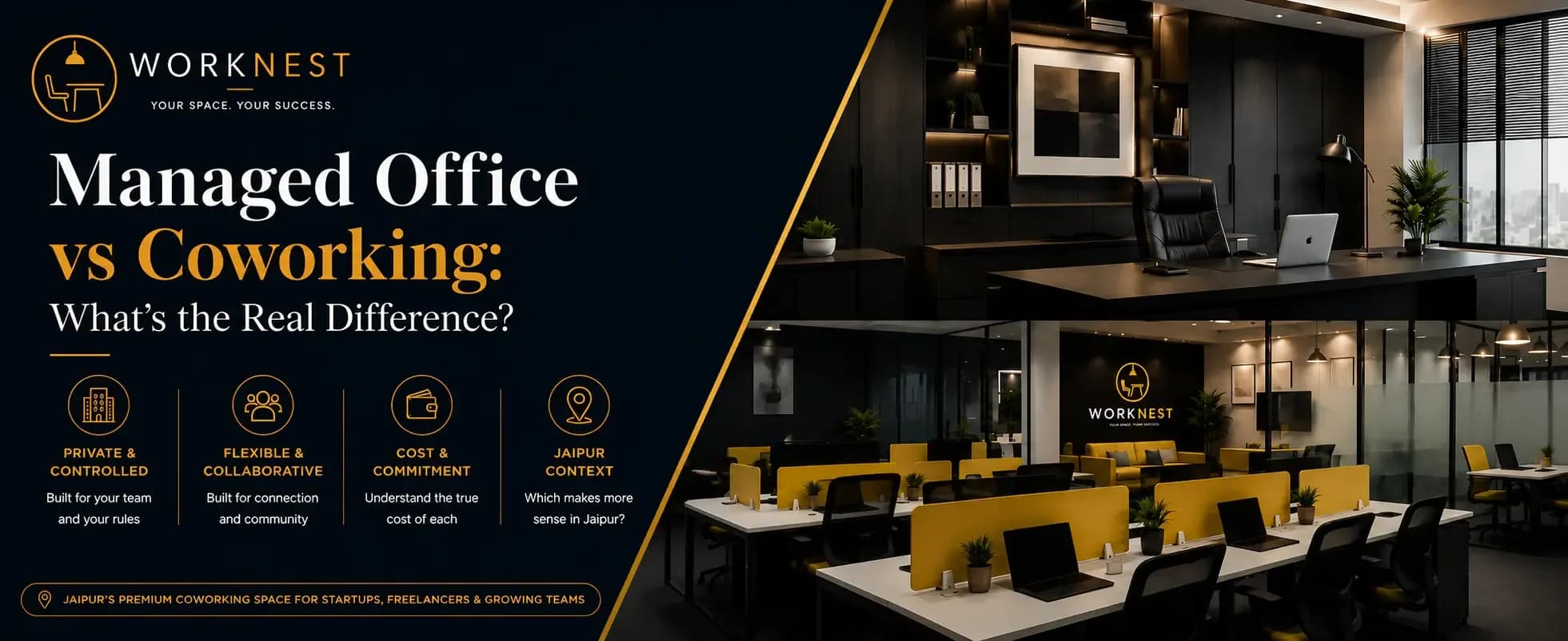
A managed office is a fully customized, privately branded workspace built and run for one company, while a coworking space is a shared, ready-to-use workspace rented by many companies at once. The real difference isn’t “premium vs budget”: it’s control and customization vs speed and flexibility. In 2026, growing SMEs in Jaipur often choose between the two because each fits a different stage of growth.
This guide breaks down both formats honestly, including where managed offices genuinely win, so you can match the format to your team’s size, budget, and timeline, not just industry hype.
What Is a Managed Office?
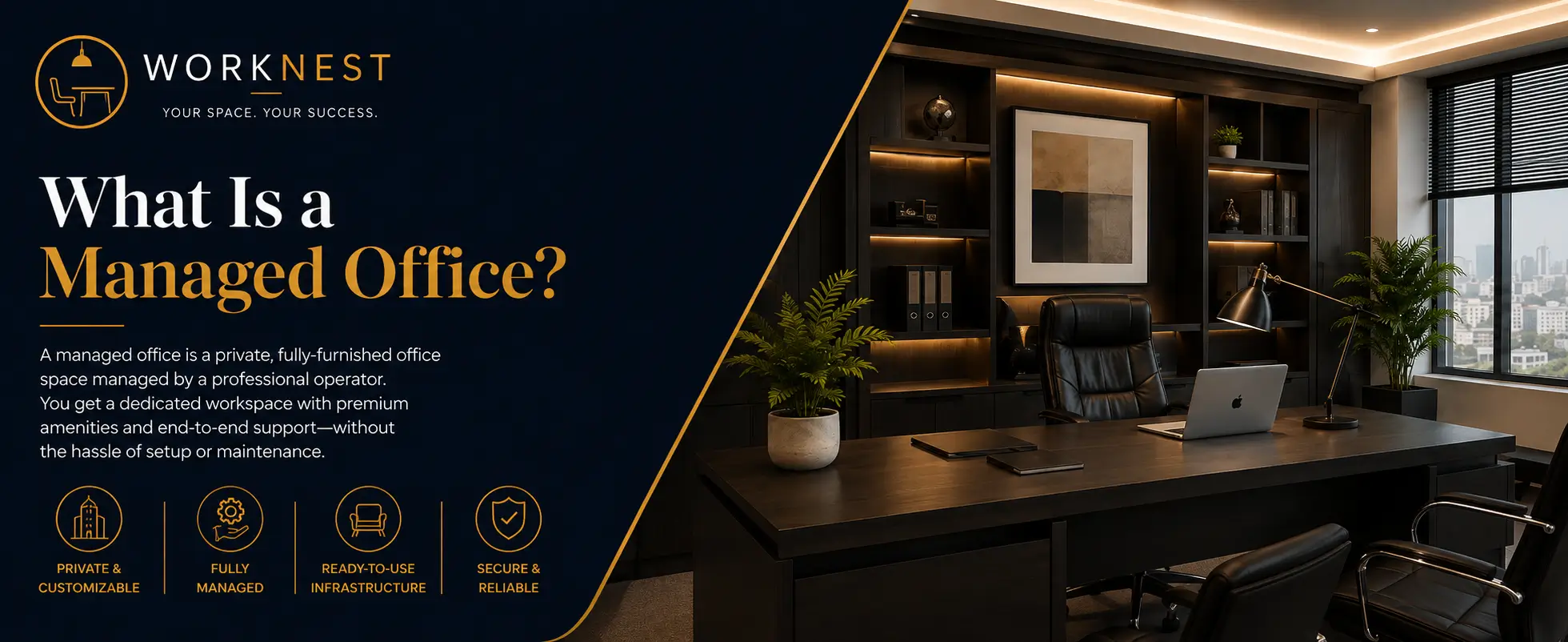
A managed office is a workspace that an operator designs, builds, and manages exclusively for your company, inside a building the operator leases or owns. You get a dedicated floor or suite, your own branding, and full control over layout, while the operator handles construction, furniture, IT infrastructure, housekeeping, and facility management.
Think of it as build-to-suit, minus the hassle. You’re not sharing a reception desk or a meeting room with strangers. Everything from the pantry to the server room is yours, configured to your specifications, and typically locked into a longer lease term than a coworking desk.
Managed offices work best when:
- Your team is large enough to fill a dedicated floor efficiently
- You need full control over branding, security, and internal layout
- You want a private, permanent address for client-facing credibility
- You’re planning to stay in the same location for 3 to 5 years
The trade-off is time and commitment. A standard commercial office fit-out typically takes 4 to 8 weeks for design and construction, based on WorkNest’s own published comparison of traditional office setup timelines; larger, fully custom managed-office floors can run longer than that baseline. Most operators also require multi-year lease commitments, typically 3 to 5 years. That’s a real cost for a team that’s still scaling and doesn’t yet know its exact headcount trajectory.
What Is Coworking?
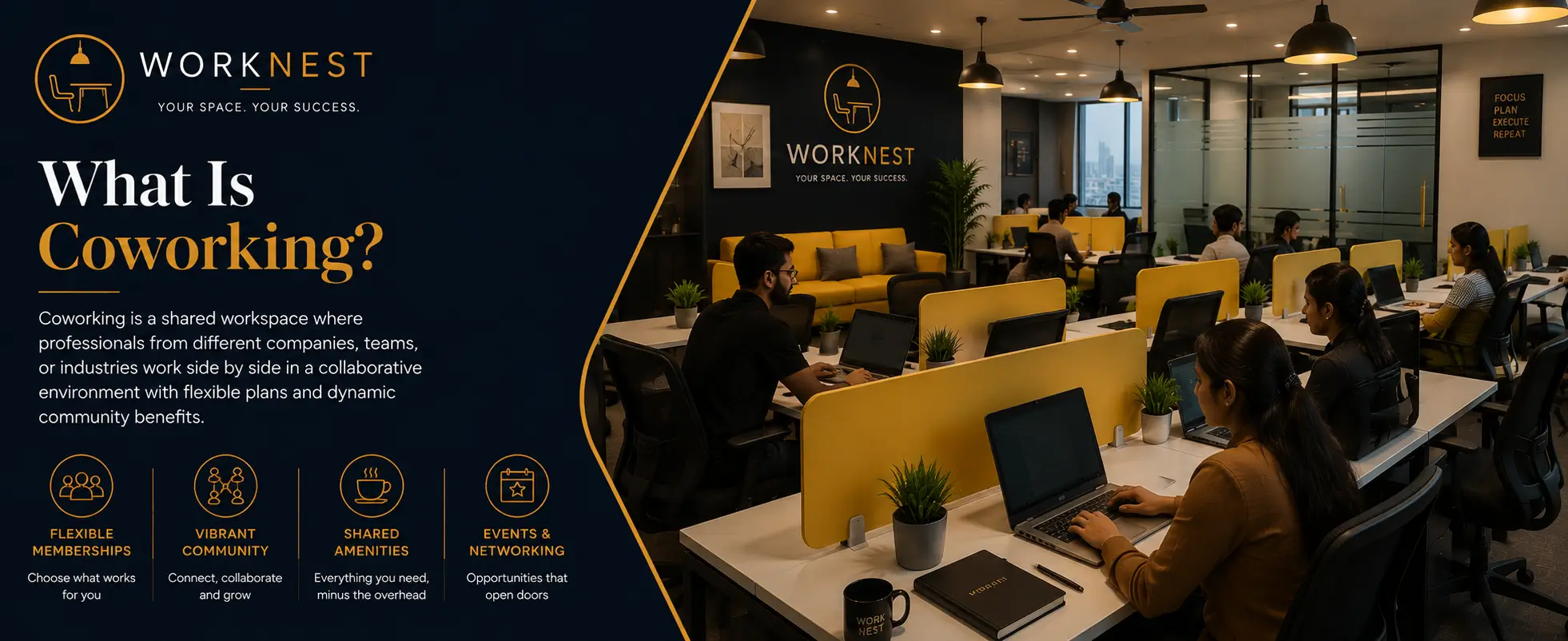
Coworking is a shared, move-in-ready workspace where individuals and companies rent desks, cabins, or meeting rooms on flexible, often month-to-month terms. The space, furniture, internet, and common amenities already exist, so you show up and start working the same day.
At WorkNest in Mansarovar, Jaipur, this looks like a Hot Desk at ₹699/day for a freelancer who needs a table for the afternoon, a Dedicated Desk at ₹9,999/month for someone who wants the same seat every day, or a Private Cabin at ₹24,999/month for a small team that wants a closed-door space without signing a five-year lease. Meeting rooms are bookable separately at ₹799/hour, so you’re not paying for conference space you use twice a week.
Coworking works best when:
- Your headcount fluctuates or is hard to predict 6 to 12 months out
- You want to avoid setup time and upfront costs for furniture or IT.
- You’re testing a new city or market before committing long-term
- You need monthly, not multi-year, financial flexibility
The trade-off is shared common areas and less control over branding: you’re one of many logos in the building, not the only one.
Key Differences
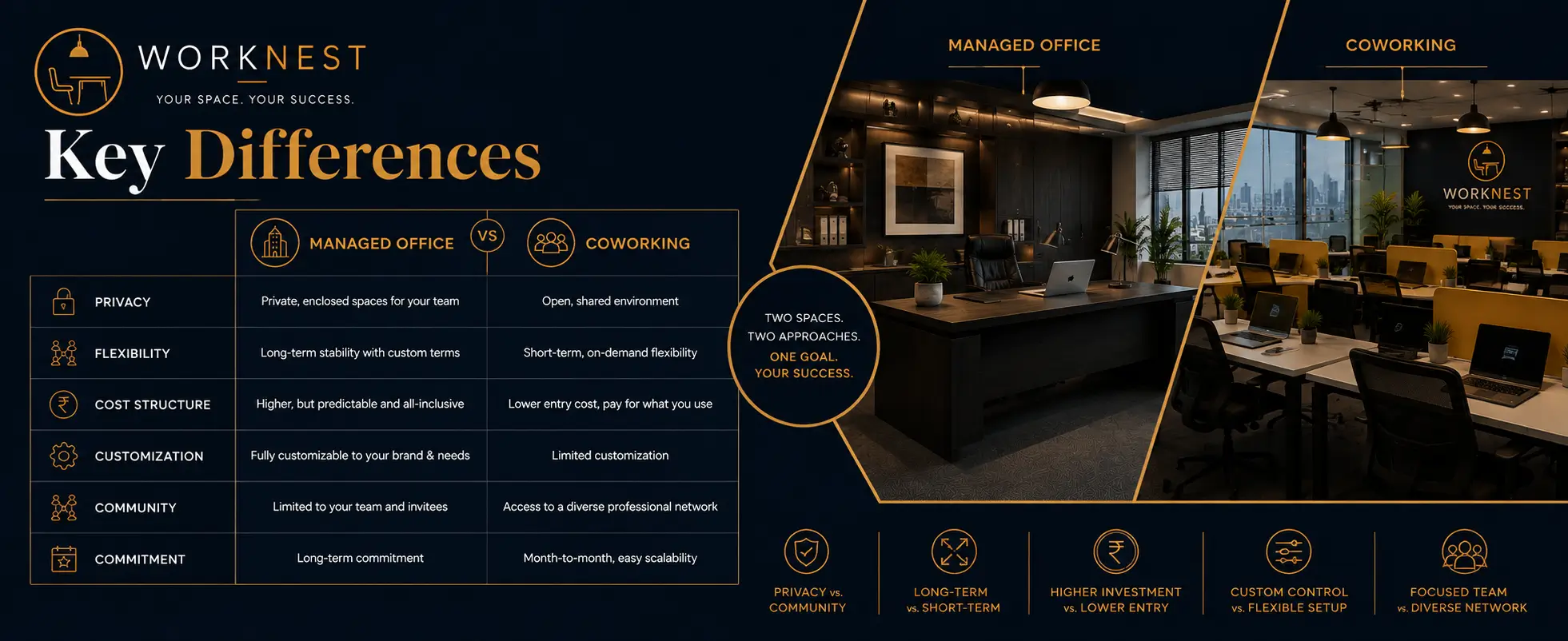
The table below is the fastest way to compare both formats side by side.
| Factor | Managed Office | Coworking Space |
|---|---|---|
| Setup time | 4 to 8 weeks for a standard build; longer for large custom floors | Same day |
| Lease commitment | Typically 3 to 5 years | Monthly to yearly |
| Branding and customization | Your own private space with full branding | Shared prices with limited branding |
| Ideal team size | 40+ seats, dedicated floor | 1 to 40 seats, flexible desks or cabins |
| Upfront cost | High: fit-out, furniture, IT build | Low to none |
| Ongoing cost predictability | Fixed per lease term | Pay as you scale |
| Amenities | Custom-built to spec | Shared: meeting rooms, pantry, internet |
| Best for | Established teams with stable headcount | Growing, testing, or scaling teams |
Where Managed Offices Genuinely Win
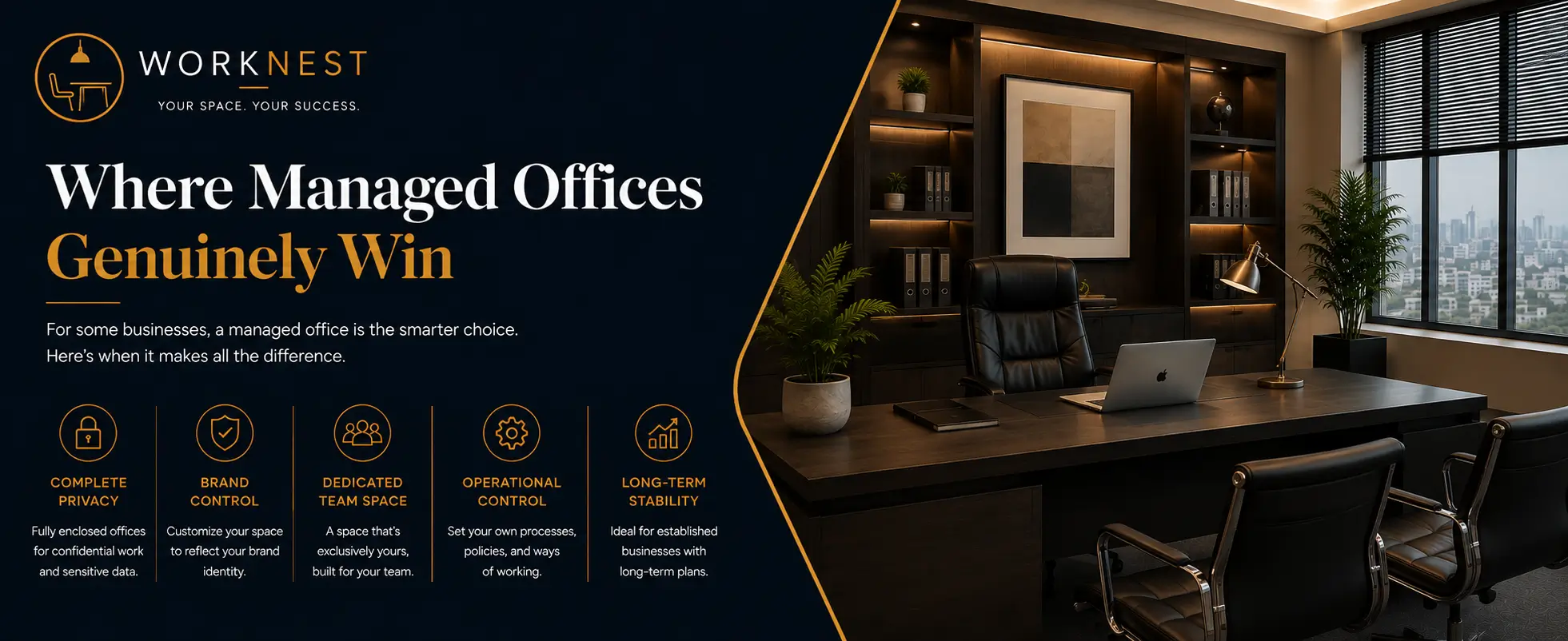
It’s tempting to frame coworking as the modern, superior choice, but that’s not honest, and it’s not what the data supports for every business. Managed offices outperform coworking on three specific fronts.
- Cost per seat at scale. Once a team reaches around 40–50 people, a custom office can often be more cost-effective than coworking because fixed costs are spread across more employees. TableSpace’s own analysis, citing CBRE-FICCI flex-office data, points to the same pattern at enterprise scale; the same underlying trend is emerging for smaller 20 to 40 seat teams too.
- Brand control. A law firm, financial services company, or enterprise client-facing team often needs a private reception, controlled visitor access, and zero shared branding, something coworking structurally cannot offer.
- Long-term space planning. If you know your headcount and location for the next 3 to 5 years, a managed office locks in favorable long-term rates that a flexible coworking membership isn’t designed to offer.
If your business fits any of these three, a managed office, not coworking, is the right call, even if it costs more upfront.
Managed Office vs Coworking: The Jaipur Context
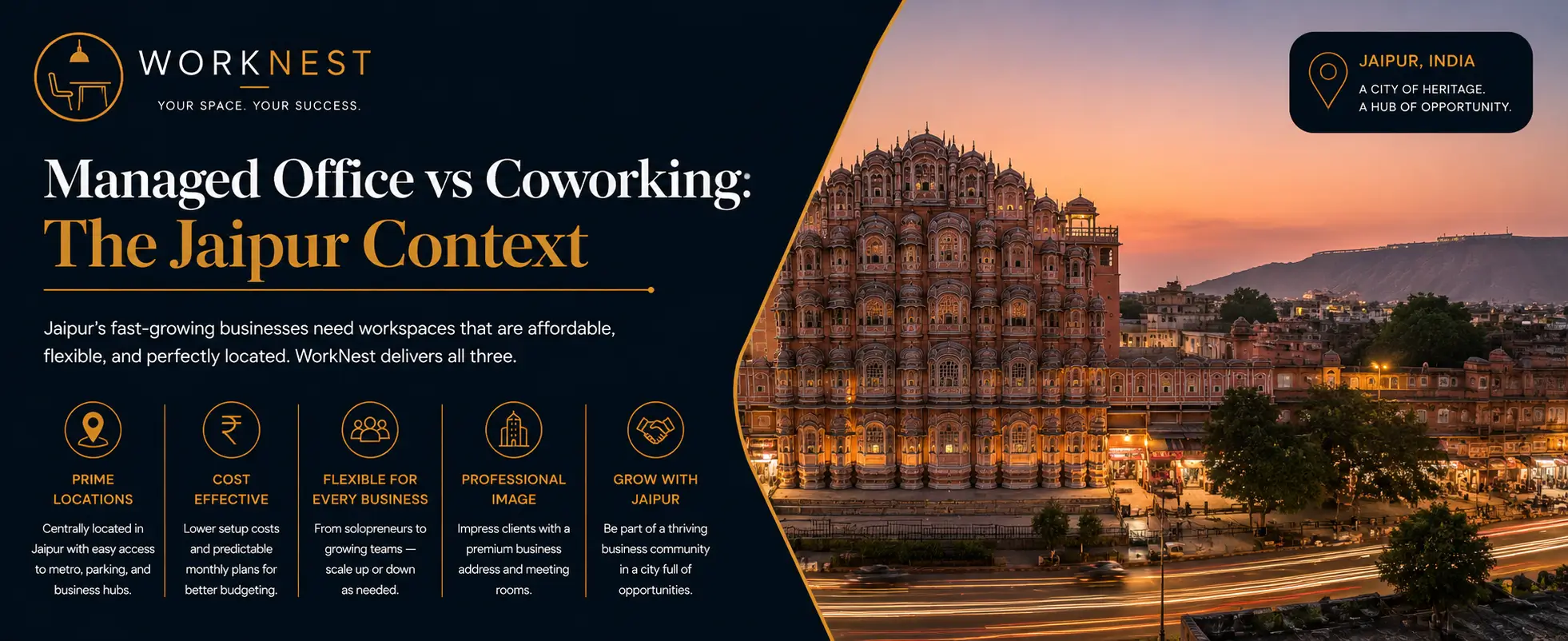
Jaipur’s flex-office market has grown fastest among SMEs and small consulting teams (1 to 25 people) rather than the 100+ seat enterprise floors that dominate metros like Gurugram or Bengaluru. That shifts the calculus locally: most Jaipur businesses evaluating “managed office space vs coworking space” are not deciding between two 50-seat options. They’re deciding whether they’ve outgrown a coworking desk yet.
A dedicated managed workspace inside a coworking building, like a Private Cabin at WorkNest, is often the practical middle ground for Jaipur SMEs: private, lockable, and branded enough for client meetings, without the multi-year commitment a full managed office requires.
Which Is Right for a Growing SME?
Neither TableSpace’s enterprise lens nor a generic India-wide comparison answers the question most Jaipur founders actually have: “We’re 5 to 25 people, which one fits us right now?”
Use this decision framework:
| Your situation | Recommended format |
|---|---|
| Team of 1 to 10, headcount uncertain | Coworking: Hot Desk or Dedicated Desk |
| Team of 10 to 25, need a private room but not a full floor | Coworking Private Cabin |
| Team of 25 to 40, stable and scaling predictably | Hybrid: Private Cabin now, managed office in 12 to 18 months |
| Team of 40+, fixed headcount for 3+ years | Managed office |
| Testing Jaipur before committing long-term | Coworking, month-to-month |
For most SMEs in this range, the real answer isn’t “pick one forever,” it’s “start in coworking, and graduate to managed as headcount and budget stabilize.” That’s also the sequence many businesses working out of WorkNest have followed, growing from a single desk into full private cabins as teams expanded.
Enterprise Flex Office: Where the Categories Blur
A newer hybrid category, enterprise flex office, sits between the two. It offers managed-office-level customization and branding, but on flexible, coworking-style lease terms, often 1 to 3 years instead of 5+. It’s aimed at mid-size companies (50 to 150 people) that want control without a decade-long real estate commitment. This is a genuine third option, and if your team is approaching that size, it’s worth asking any operator, including WorkNest, whether a flex-managed hybrid is available before signing a traditional managed office lease.
What This Looks Like in Practice
“Moving to WorkNest cut our office setup time from two months to two days,” says Aditi Rao, Founder. That’s the practical speed advantage coworking has over a traditional build-out, and it’s the same advantage that makes coworking the right starting point for most growing teams.
The same flexibility holds as teams expand. “We started with four desks and expanded to a cabin without changing address,” says Arjun Nair, Founder. That’s the practical advantage coworking has that a managed office, by design, doesn’t: you can grow into your space instead of pre-committing to it.
The Bottom Line
If you know your headcount for the next several years and need full branding control, a managed office is worth the setup time and lease commitment. If you’re still scaling, testing, or simply want predictable monthly costs without capex, coworking, including a private, lockable option like a WorkNest cabin, gets you working today without locking you in.
WorkNest currently supports 500+ businesses across Jaipur, holds a 4.8 Google rating, and sees a 91% renewal rate: evidence that flexible, coworking-first setups keep working for growing teams long after the first lease term ends.
Ready to see which format fits your team? Book a Free Office Tour at WorkNest’s Mansarovar campus and walk through Hot Desks, Dedicated Desks, and Private Cabins before you commit to anything.
FAQs
Q: What is the main difference between a managed office and a coworking space?
A managed office is a private, fully customized workspace built exclusively for one company, usually on a multi-year lease. A coworking space is a shared, move-in-ready workspace rented flexibly, often month-to-month, by many companies at once.
Q: Is a managed office more expensive than coworking?
Upfront, yes: managed offices require fit-out and furniture costs coworking doesn’t. At scale (40+ seats), the per-seat cost can become competitive with coworking, but for teams under 40 people, coworking is typically the lower-cost option (industry estimate, not vendor-verified).
Q: Can a coworking membership convert into a managed office later?
Many operators, including flex-focused providers, let growing teams move from shared desks to private cabins and eventually into dedicated managed space as headcount stabilizes, rather than requiring a hard switch.
Q: What is included in a managed office setup?
Typically: dedicated floor or suite, custom furniture and branding, IT infrastructure, housekeeping, and facility management, all built to the tenant’s specification rather than shared with other companies.
Q: How much does a managed office cost in Jaipur?
Managed office pricing in Jaipur varies by location, fit-out level, and lease term, and is generally quoted per seat per month on a custom basis (market estimate, verify before publishing). For comparison, WorkNest’s coworking Private Cabins start at ₹24,999/month with no separate fit-out cost.
Q: What is an enterprise flex office?
It’s a hybrid format offering managed-office-level branding and customization on shorter, coworking-style lease terms (often 1 to 3 years), aimed at mid-size companies that want control without a long-term real estate commitment.
Q: Is coworking suitable for a growing startup in Jaipur?
Yes: coworking is designed for exactly this scenario, with uncertain headcount, limited capex, and the need to start working immediately. Teams can begin on a Dedicated Desk and move into a Private Cabin as they hire.
Q: When should an SME upgrade from coworking to a managed office?
Generally once headcount stabilizes above roughly 40 people and the company can commit to one location for 3+ years. Below that threshold, coworking’s flexibility usually outweighs a managed office’s control (industry estimate, not vendor-verified).