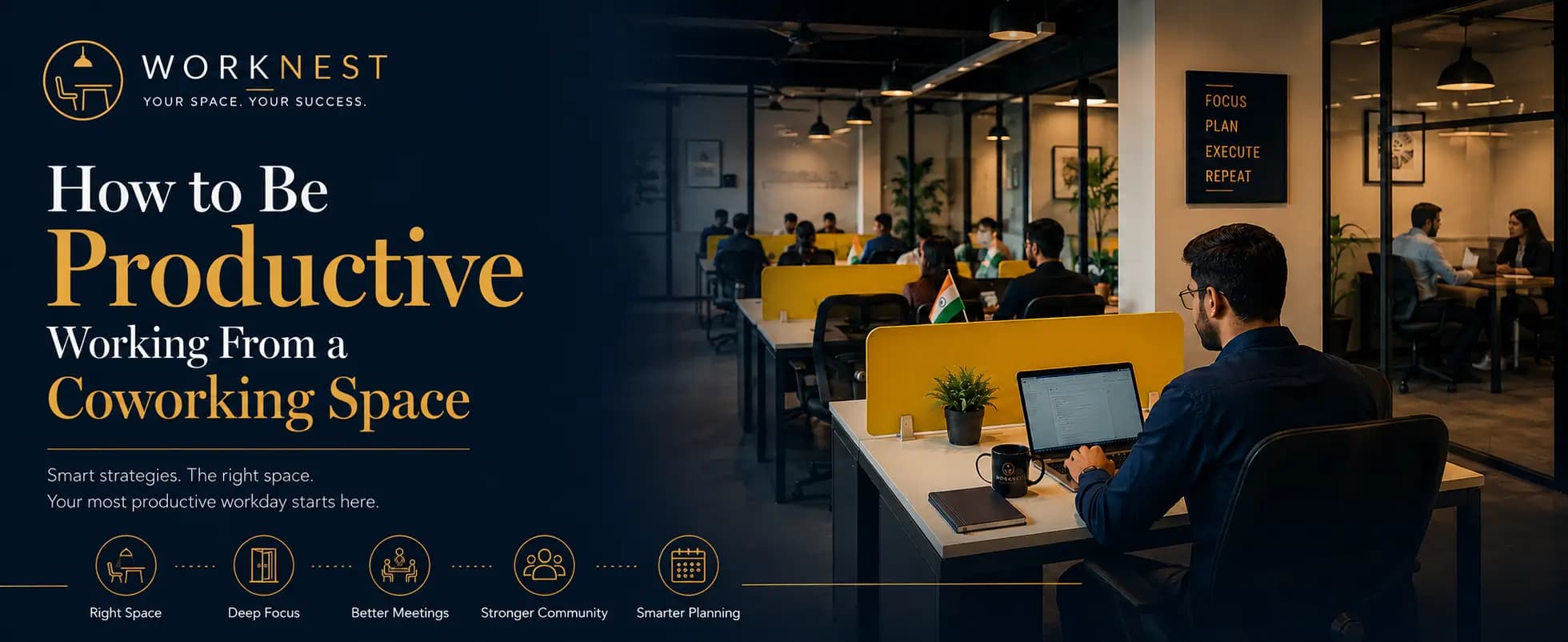
The fastest way to stay productive in a coworking space is to match your desk type to your task, build a repeatable routine, and use zoned areas, like private cabins for deep work and meeting rooms for calls, instead of working from one seat all day. As of 2026, this “task-to-space” approach is what separates coworking members who thrive from those who drift.
Coworking spaces solve the isolation of working from home, but they introduce a new problem: too much choice and too much stimulation. A packed hot-desk floor, constant footsteps, and the pull of the community lounge can wreck your focus just as easily as a noisy kitchen at home. The good news is that productivity in a shared office isn’t about willpower. It’s about structure.
Most productivity guides for coworking spaces hand you a generic tip list and stop there. They rarely tell you which bookable space to actually use for which task. This guide does. Every tip below is tied to a real, bookable amenity you can act on today.
At WorkNest in Mansarovar, Jaipur, we’ve helped 500+ businesses find what works for them, each at their own pace. Below are the tips that actually move the needle, tied to real, bookable amenities you can use starting today.
1. Match Your Desk Type to Your Task
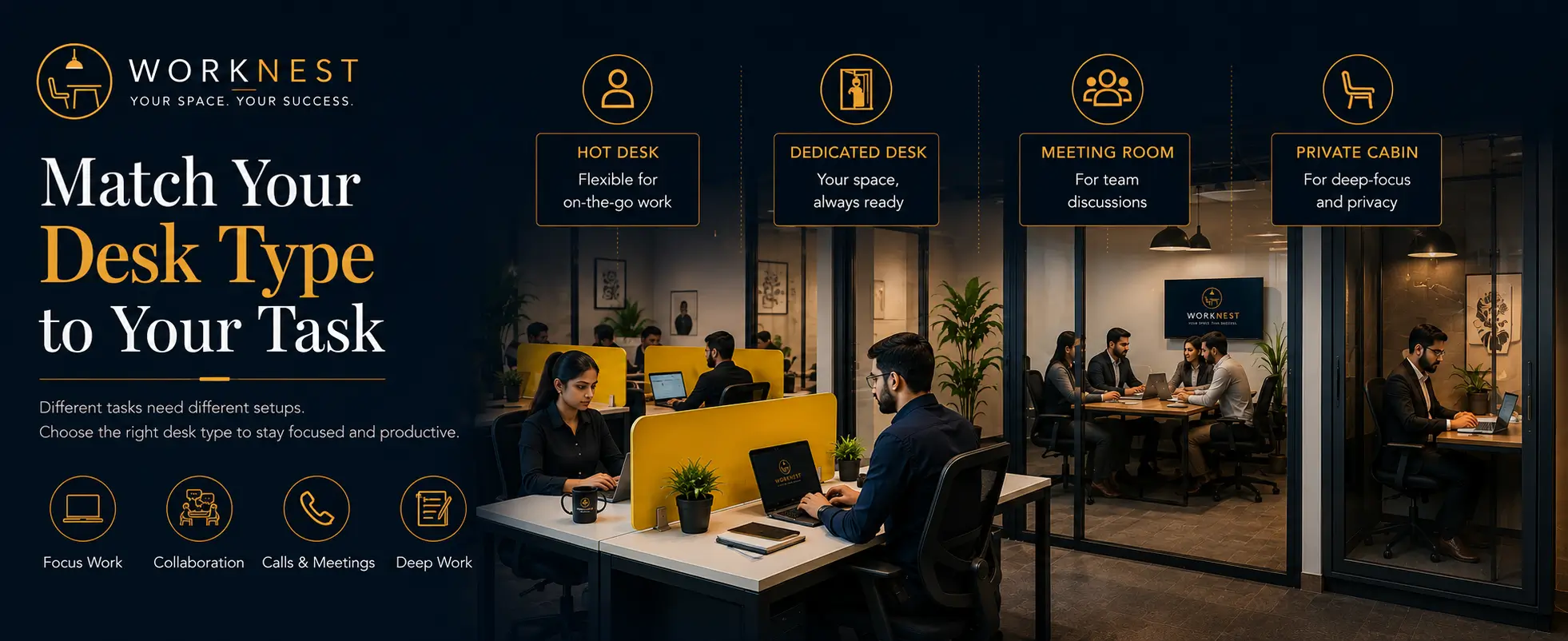
Most coworking advice stops at “get a desk.” But not every task needs the same desk. Treat your desk type as a productivity tool, not just a seat.
| Desk Type | Best For | Price |
| Hot Desk | Occasional visits, light admin work, flexible days | ₹699/day |
| Dedicated Desk | Daily routine, consistent workflow, personal setup | ₹9,999/month |
| Private Cabin | Deep-focus work, client calls, confidential tasks | ₹24,999/month |
| Meeting Room | Interviews, pitches, team syncs | ₹799/hour |
If you’re at WorkNest three or more days a week, a Dedicated Desk removes the daily decision of “where do I sit,” which is a small but real drain on focus. Founder Aditi Rao puts it simply: “Having the same desk every day cut my setup time to zero. I just sit down and start.”
2. Build a Routine You Repeat, Not Reinvent
Productivity hacks fail when they’re one-off tricks. A coworking space routine works because it removes decisions. Try this structure:
- Arrive at the same time each day to anchor your body clock.
- Do your hardest task first, before the floor fills up and noise rises.
- Batch shallow work, email, scheduling, admin, for the afternoon lull.
- Leave at a consistent time so your brain learns the workday has an edge.
Consultant Rohan Mehta books the same hot desk near the window every morning: “It’s not about the seat. It’s about starting the day the same way, every time.”
Here’s what that looks like in practice. Rohan usually gets to WorkNest around 9:30 AM on most weekdays. He spends the first 90 minutes on client strategy work, before the floor gets busy. Between 11 AM and 1 PM, he handles calls and admin. After lunch, he batches any remaining meetings, then wraps up by 6 PM. The schedule rarely changes, and that’s the point. A fixed routine removes the daily question of “what should I work on next?” and leaves more mental energy for the work that really matters.
3. Use Private Cabins for Deep-Focus Days
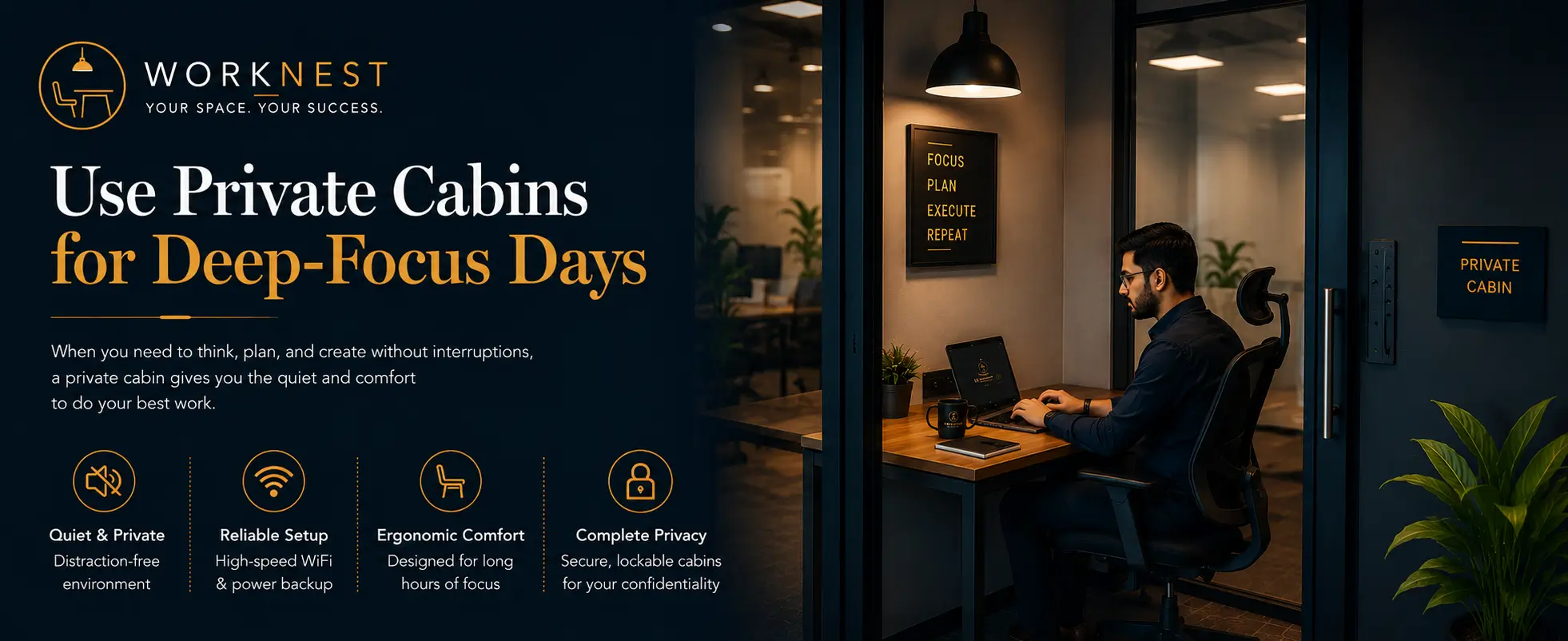
This is the tip most competitor articles skip entirely: your environment should change based on the type of work, not stay fixed. When a task needs two or three hours of uninterrupted focus, like a proposal, financial model, or design sprint, book a Private Cabin instead of trying to concentrate on the open floor.
Freelance designer Priya Singh switches to a cabin for client deliverables: “On the open floor, I get pulled into conversations. In the cabin, I finish in half the time.”
At ₹24,999/month, a Private Cabin isn’t a daily requirement for most members. It’s a tool you use when the day really matters.
4. Batch Meetings Into One Room, One Block
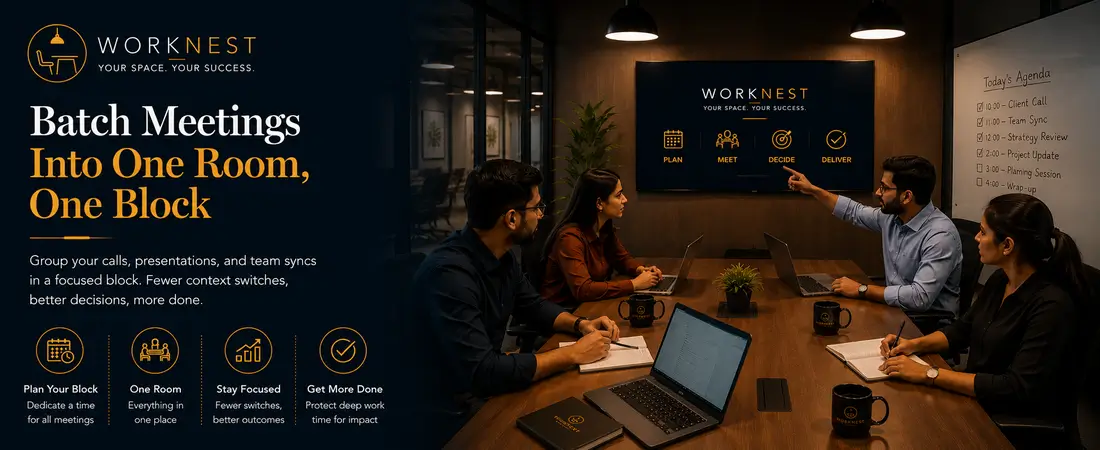
Constantly leaving your desk for calls disrupts your focus and everyone else’s. Instead, batch your calls and meetings into a single block and book WorkNest’s Meeting Room for ₹799/hour.
Sales lead Karan Malhotra batches client calls between 2 PM and 4 PM: “Everything outside that window waits. It has almost completely eliminated interruptions during my deep work.
This also protects your desk time. The rest of your day stays free for focused, uninterrupted output.
5. Set Zone Rules for Yourself
Coworking floors aren’t neutral. Some zones invite conversation, others invite focus. Learn which is which at your space and use them on purpose.
| Zone | Best Used For |
| Lounge / café area | Quick chats, casual calls, breaks |
| Open desk floor | Routine work, moderate-focus tasks |
| Private cabin | Deep work, confidential work, high-stakes deadlines |
| Meeting room | Scheduled calls and meetings only |
Treating zones as tools, not just furniture, is the single biggest gap in most generic coworking advice.
6. Take Breaks on Purpose, Not by Accident
Unstructured breaks (a scroll here, a chat there) add up fast in a social environment. Structured breaks protect your time instead. Try a short walk, a coffee break away from your desk, or five minutes of stretching every 90 minutes.
Unplanned breaks cost more than they seem. A study from the University of California, Irvine, found that getting back into a task after an interruption can take around 23 minutes. So, a five-minute scroll can easily cost much more than five minutes of focus.
The goal isn’t to avoid breaks. It’s to take breaks you choose, rather than breaks that happen to you.
7. Use the Community as an Asset, Not a Distraction

One advantage a coworking space has over a home office is the people around you. Agency partner Meera Jain treats WorkNest’s community events as scheduled networking, not spontaneous interruptions: “I attend the events I plan for and skip the floor chatter I didn’t.”
The fix is simple: engage with the community on your terms, at events, during breaks, over lunch, not every time someone walks past your desk.
8. Review Your Week and Adjust Your Setup
At the end of each week, ask which days you were sharpest and where you sat. Founder Arjun Nair reviews this monthly: “I noticed I get more done in the cabin on Mondays and Tuesdays, so now I book it in advance for those two days.” Small adjustments like this compound over a quarter.
9. Set a Weekly Desk-Type Budget
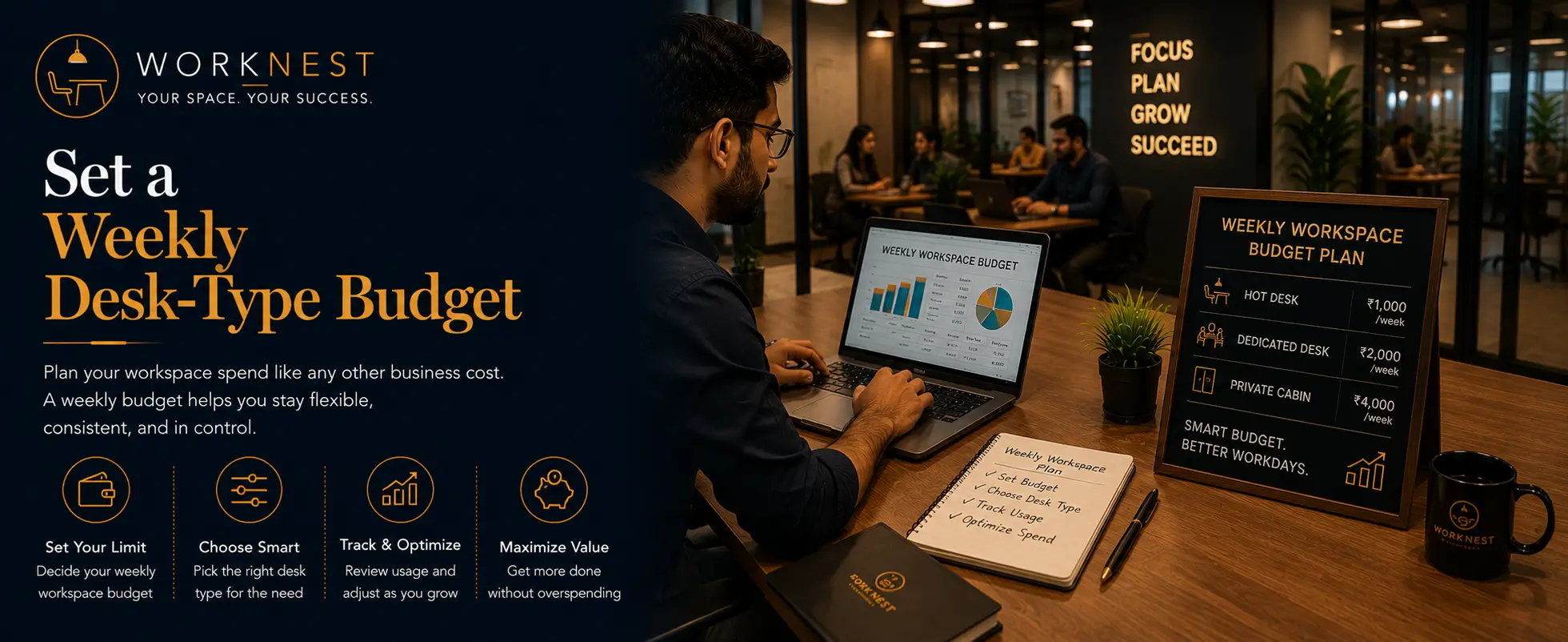
Most members default to one desk type and stick with it, even when the work changes week to week. Instead, plan your desk type the way you’d plan a budget. Look at your calendar every Monday and ask: how many deep-focus days do I have this week, how many meeting-heavy days, and how many routine days?
Founder Arjun Nair does this at the start of every week: he books the Private Cabin for one or two focus-heavy days, keeps his Dedicated Desk for the rest, and reserves the Meeting Room only on days with client calls. This turns your workspace choice into a weekly decision instead of a fixed habit. It means you’re never paying for more cabin time than you actually need, or fighting for desk space on a day that needed a cabin.
The Bottom Line
Productivity in a coworking space isn’t about finding the perfect desk once. It’s about matching the right desk, room, and routine to the work in front of you, week after week. WorkNest members who do this consistently are part of why our renewal rate sits at 91%. People stay because the system works, not just the space.
This is also why generic tip lists fall short. Knowing you should “avoid distractions” doesn’t help if you don’t have a private cabin to escape to, or a meeting room to batch your calls into. The tips above work because they’re built around real, bookable spaces, not abstract advice you can’t act on.
WorkNest has applied this approach with 500+ businesses across Mansarovar, Jaipur, and holds a 4.8 Google rating, with a 30-minute response time for new inquiries. Whether you’re a founder, freelancer, consultant, or sales lead, the setup that works for you already exists here. You just need to book the right one for the day ahead.
If you want to test this approach yourself, book a free office tour and try a Hot Desk, Dedicated Desk, or Private Cabin at WorkNest, E-3, 6D Engineers Colony, Mansarovar, Jaipur 302020, and find out which setup makes you most productive.
Book a Free Office Tour →
FAQs
Q: What is the best desk type for productivity in a coworking space?
A: It depends on the task. Use a Hot Desk (₹699/day) for occasional visits and light work, a Dedicated Desk (₹9,999/month) for daily routine work, and a Private Cabin (₹24,999/month) for deep-focus or confidential tasks.
Q: How do I avoid distractions in a coworking space?
A: Use zoned seating on purpose: open desks for routine work, private cabins for deep focus, and meeting rooms for calls, instead of doing every type of task from the same seat.
Q: Is a private cabin worth it for focus work?
A: Yes, for high-stakes or deadline-driven tasks. Members typically use a cabin selectively, not daily, reserving it for work that needs two or more uninterrupted hours.
Q: How much does a coworking space cost in Jaipur?
A: At WorkNest, pricing starts at ₹699/day for a Hot Desk, ₹9,999/month for a Dedicated Desk, ₹24,999/month for a Private Cabin, and ₹799/hour for a Meeting Room.
Q: What’s a good daily routine for staying productive at a coworking space?
A: Arrive at a consistent time, do your hardest task first, batch meetings into one block, batch shallow admin work for the afternoon, and leave at a consistent time.
Q: Do coworking spaces help freelancers stay accountable?
A: Yes. A fixed arrival time, a consistent desk, and a professional environment create structure that’s harder to maintain working from home alone.
Q: How do I stop letting the coworking community distract me?
A: Engage with community events and conversations at set times, like lunch or scheduled events, rather than every time someone passes your desk.
Q: Should I switch desk types depending on my workload?
A: Yes. Instead of sticking to one desk type all the time, review your calendar weekly and match your setup to that week’s mix of deep-focus days, meeting-heavy days, and routine days.