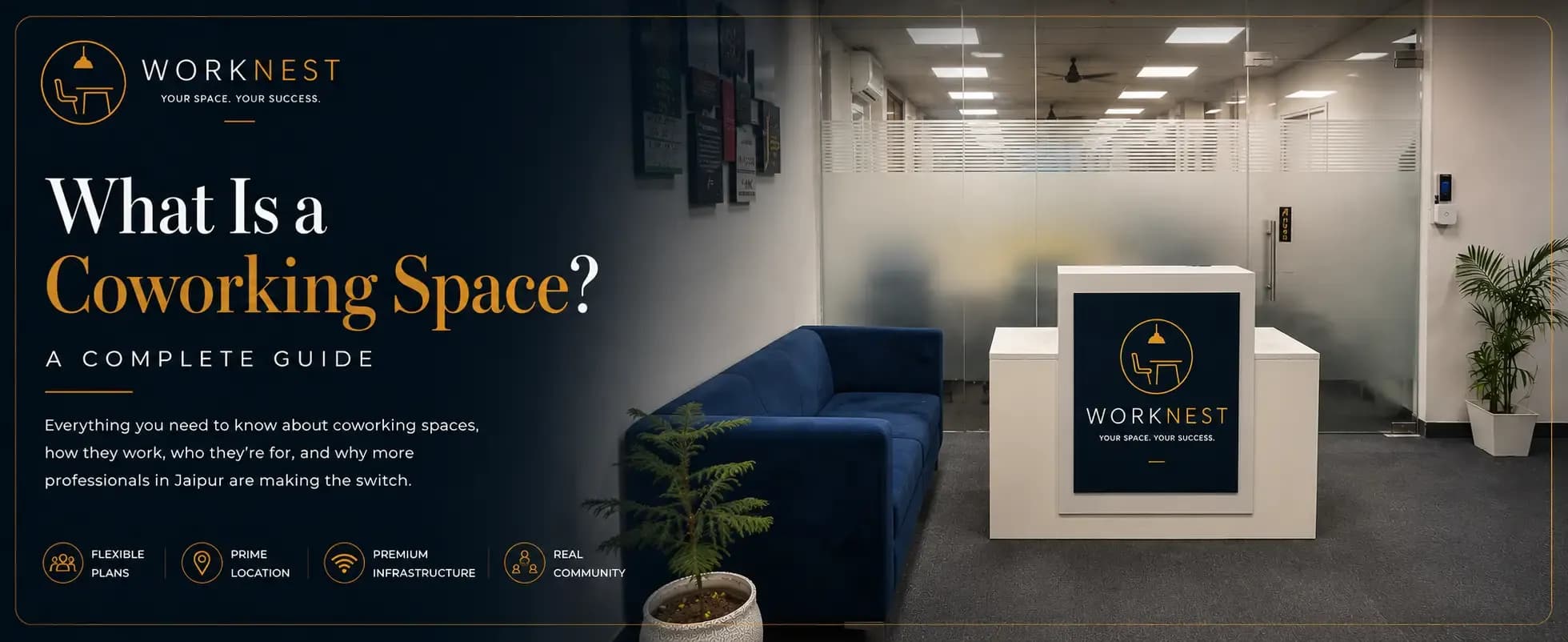
If you’re searching “what is a coworking space,” you’re probably at one of a few points: working from your kitchen table and losing focus, running a small team out of a cafe and tired of unreliable Wi-Fi, or an HR or ops lead scouting real office options for a team that’s outgrown remote work. A coworking space is a shared, professionally managed office where individuals and businesses rent desks, cabins, or meeting rooms splitting the cost of infrastructure like internet, furniture, and community, without signing a rigid, multi-year lease.
At WorkNest, we’ve built exactly that for Jaipur which is why over 500 businesses currently work out of our floors, and why members rate us 4.8 out of 5. This guide walks through what a coworking space actually includes, what it costs, how it compares to working from home or a traditional office, and how to tell if it’s the right fit for your stage of business.
What Is a Coworking Space?
A coworking space is a shared workspace where professionals from different companies work under one roof, each paying only for the desk, cabin, or plan they use. You’re not renting an entire office you’re renting access to one, along with everything that comes with it.
What makes it different from a regular rented office is simple: you share the building, but never your work, your clients, or your team. Think of it less like renting an apartment and more like a serviced hotel room for your business full amenities, none of the maintenance headaches.
The model isn’t a fad. It grew out of a real problem: traditional office leases were expensive, rigid, and completely impractical for a two-person startup or a solo consultant. Coworking removed that barrier, and it’s now one of the fastest-growing segments of commercial real estate in India, with Tier-2 cities like Jaipur increasingly part of that growth.
What’s Actually Included in a Coworking Membership?
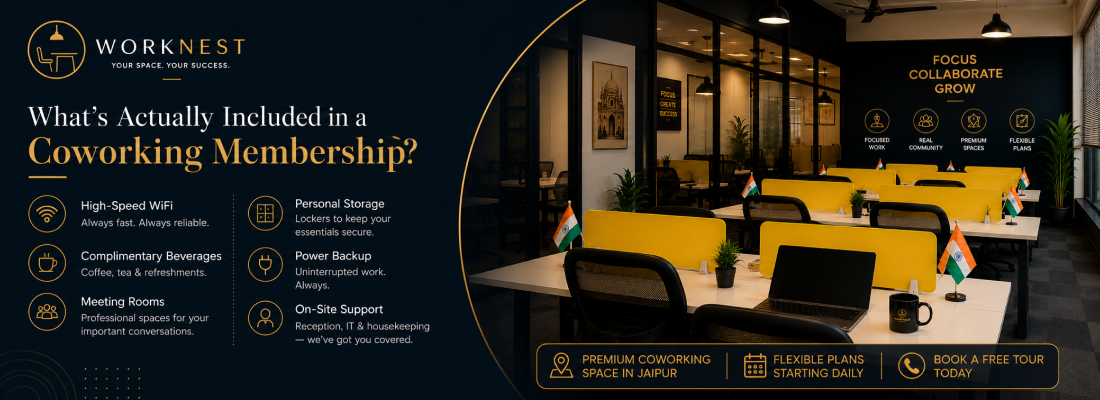
This is usually the first question first-time searchers have, and the honest answer is: it depends on the operator, so always ask for a full breakdown before signing. At a typical well-run coworking space (including WorkNest), your monthly plan covers:
- High-speed Wi-Fi, usually with a backup connection so a single outage doesn’t stop your workday
- A desk or cabin — hot desk, dedicated desk, or a private lockable cabin, depending on your plan
- Meeting rooms, usually with a set number of free hours included per month
- Power backup, ideally across the whole floor, not just common areas
- Pantry access, from basic tea and coffee to a full cafe-style setup
- Community and networking, since you’re working alongside founders, freelancers, and small teams from other industries
- Reception and basic admin support, so you’re not answering your own front door
What’s usually billed separately: extra meeting room hours, dedicated parking, courier handling, and premium food and beverage service. Ask for this list in writing before you sign anything.
Step Inside: What a Coworking Floor Actually Looks Like
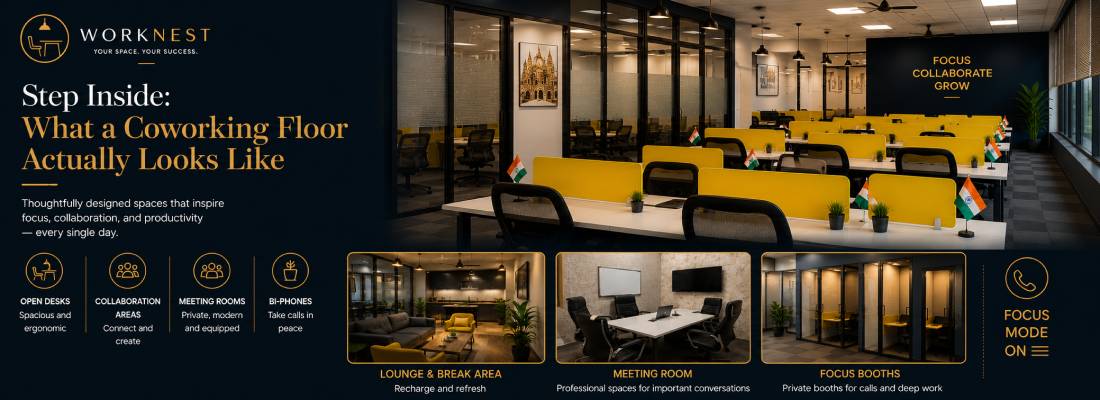
[Image placeholder — swap in an existing WorkNest gallery photo here, with alt text like “WorkNest coworking floor, Jaipur, showing open desks and meeting room”]
Picture an open floor with natural light coming in through floor-to-ceiling windows, rows of clean desks with ergonomic chairs, and a scatter of laptops, coffee cups, and sticky notes. Off to one side, a glass-walled meeting room is booked for a 10 a.m. client call. Near the pantry, two founders from unrelated businesses are comparing notes over coffee. Somewhere behind them, a phone booth is occupied by someone taking a call they’d never risk in a cafe corner. It’s quieter than a cafe, less isolating than a home office, and far less sterile than a typical corporate floor that combination is usually what convinces a first-time visitor to switch.
Coworking vs Home Office vs Traditional Office
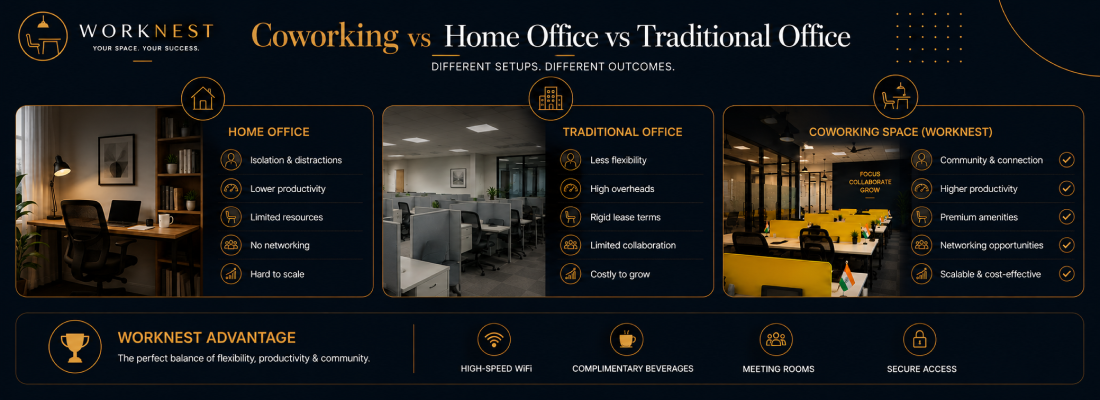
The comparison that actually matters for most first-time searchers isn’t “coworking vs managed office” it’s whether to leave the kitchen table or the cafe corner altogether. Here’s how the three stack up:
| Factor | Coworking Space | Home Office | Traditional Office Lease |
| Upfront cost | Minimal — move in same week | None, but you supply everything yourself | High (deposit, fit-out, furniture) |
| Contract length | Month-to-month or short minimum | None | Typically 3+ years |
| Internet & power backup | Included | Your responsibility | Your responsibility to set up |
| Meeting rooms for clients | Included, bookable by the hour | Not available | Must be built in |
| Professional address | Yes | No | Yes |
| Work-life separation | Strong — dedicated space away from home | Weak — blurred boundarie | Strong |
| Networking & community | Built in | None | Limited to your own team |
If home or cafe work has started costing you focus, client credibility, or hours lost to unreliable Wi-Fi, that’s usually the signal it’s time to move into a proper workspace
Is Your Team the Right Fit for a Coworking Space?
Coworking plans aren’t one-size-fits-all. A solo consultant and a 15-person startup need very different setups:
- Hot Desk: Best for freelancers and consultants who don’t need the same seat every day.
- Dedicated Desk: A fixed seat on a shared floor ideal for solo founders or 2–3 person teams.
- Private Cabin: A lockable room for roughly 4–15 people who need confidentiality without a fully managed floor.
If you’re an HR or ops lead scouting options on behalf of a team, it’s worth mapping headcount against growth plans before you shortlist anything. A plan that fits a 6-person team today can get cramped fast if you’re hiring aggressively over the next two quarters ask any operator whether you can add seats mid-contract without renegotiating the whole agreement.
Why Jaipur Professionals Are Making the Switch
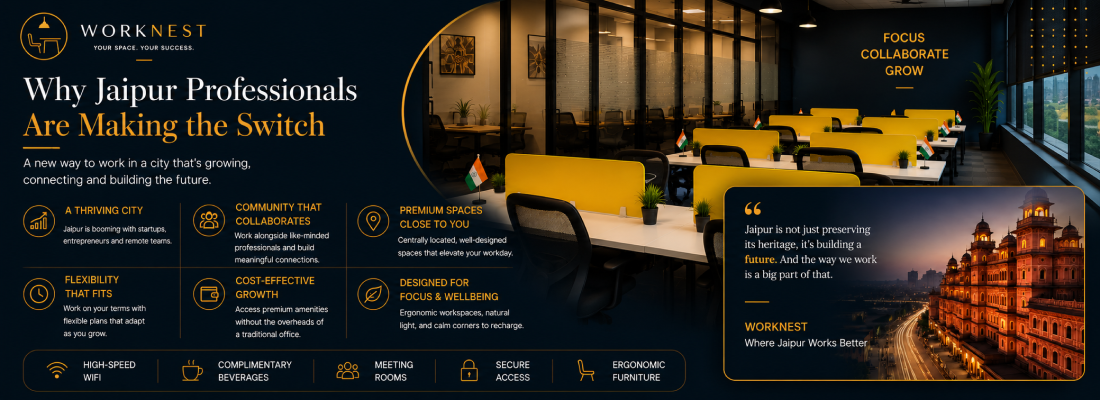
Jaipur’s coworking scene has grown quickly, and it’s not just a local trend. According to Cushman & Wakefield’s Global Trends in Flexible Office 2025 report, India now scores a perfect 100 on the firm’s flexible-office maturity index ahead of markets like the UK, France, and the US and the report points to demand increasingly spreading beyond metros into Tier-2 cities, Jaipur included. In plain terms: this isn’t a niche experiment anymore, it’s a mainstream way of working, and Jaipur is very much part of that shift.
Locally, three things are driving the move: operational costs well below metro cities like Mumbai or Bengaluru, a steady stream of talent from Jaipur’s engineering and business colleges, and growing government support for business activity outside the traditional metro hubs.
What Does a Coworking Space Cost in Jaipur?
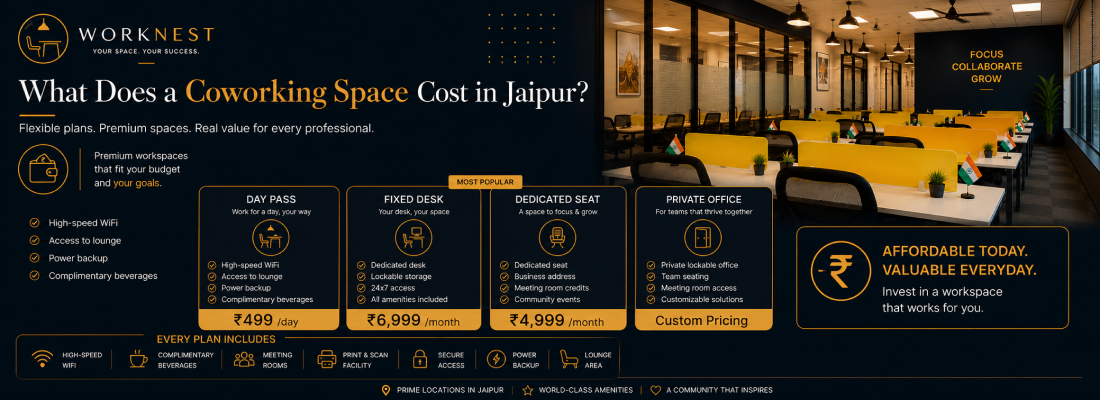
Pricing varies by location and plan, but as a general reference, most coworking seats in Jaipur fall between ₹5,000 and ₹15,000 per seat per month, excluding GST. Hot desks sit at the lower end, dedicated desks in the middle, and private cabins cost more per head though they typically stay more cost-efficient than a fully managed office until a team grows past 30–40 seats.
Ask any operator, including us, for a written breakdown of what’s included versus billed separately that’s the single best way to avoid surprise costs at renewal time. Hidden costs are usually the biggest source of frustration for first-time coworking members, and almost all of them trace back to a plan that was never fully explained upfront not to the coworking model itself.
Frequently Asked Questions
1. What is a coworking space in simple terms?
It’s a shared office where people from different companies each pay only for their own desk, cabin, or plan, while splitting the cost of shared amenities like Wi-Fi, meeting rooms, and community space.
2. Is coworking cheaper than renting a traditional office?
For teams under roughly 30–40 people, yes you avoid the upfront fit-out cost, long lease commitment, and facility management overhead that come with a traditional office.
3. Do I need a long contract to join a coworking space?
No. Most coworking memberships, including WorkNest’s, run month-to-month or on a short minimum term one of the biggest advantages over a traditional lease.
4. What’s usually NOT included in the monthly price?
Extra meeting room hours beyond your plan’s allowance, dedicated parking, courier handling, and premium food and beverage service are typically billed separately. Always ask for this list before signing.
5. How do I know if my team is the right size for coworking?
Roughly 1–30 people fits comfortably into a coworking plan solo freelancers and small teams usually start with a hot desk or dedicated desk, while teams needing more privacy move into a private cabin. Beyond 30–40 people, a managed office usually makes more sense. If you’re scaling quickly, ask upfront whether your plan can flex with you rather than locking you into a fixed seat count.
Ready to See It in Person?
Reading about a coworking space only gets you so far — the fastest way to know if it fits is to sit at a desk for an afternoon. Book a free tour of WorkNest’s Jaipur workspace →